
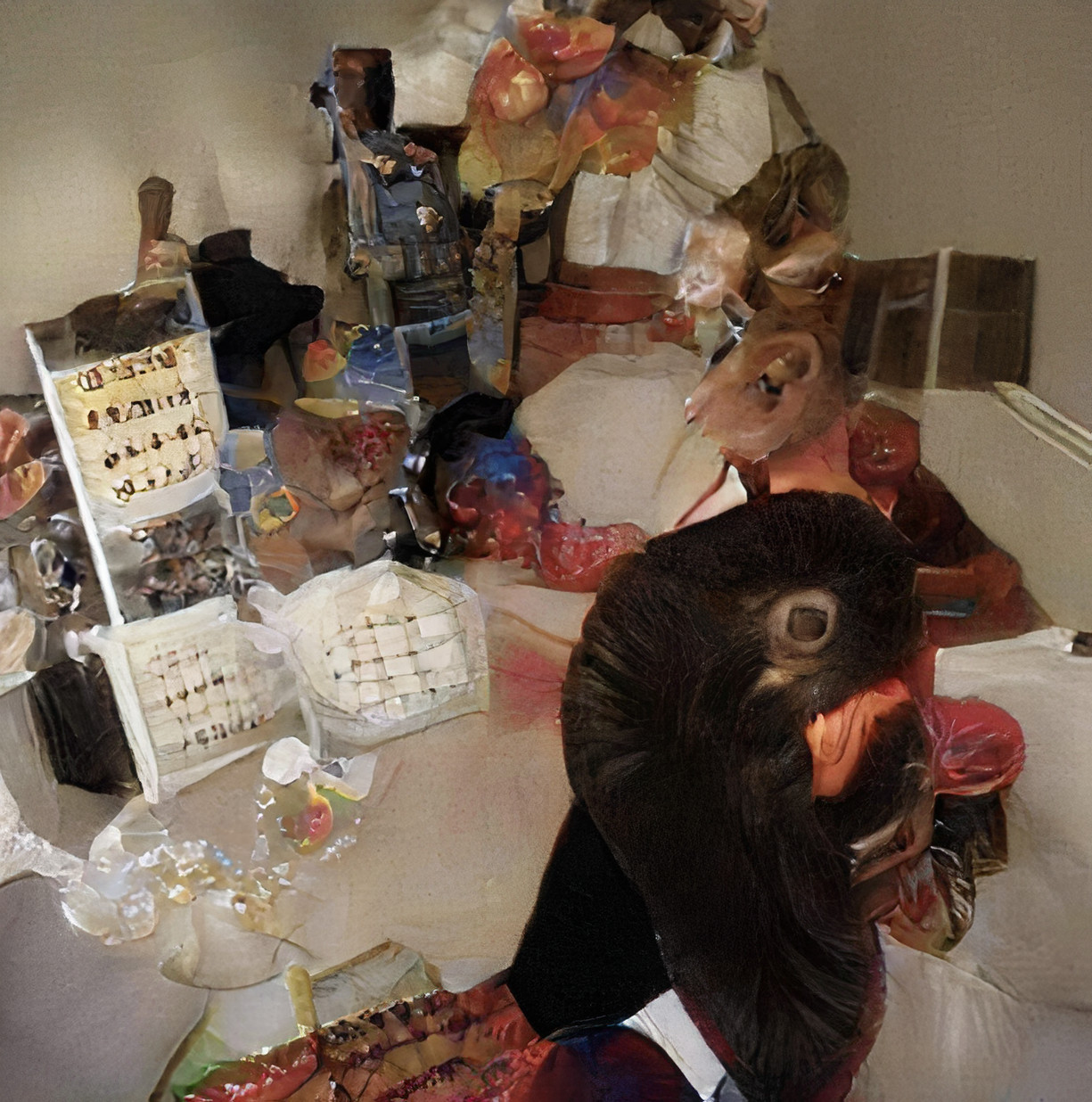
Name one thing in this picture, via Effect Index
Visual agnosia
A dissociative visual-cognitive effect in which the observer can physically see objects with normal or near-normal clarity but loses the ability to mentally recognize or identify what they are looking at — rendering even familiar, everyday objects incomprehensible.
Description
Visual agnosia in the psychoactive context is a deeply disorienting effect in which the connection between seeing andunderstanding is severed. The eyes continue to function normally — visual acuity may be entirely intact, and the observer can perceive shapes, colors, textures, and spatial relationships with full clarity. But the higher-order cognitive processing that normally, automatically, and instantly converts raw visual data into recognized objects simplystops working. A chair is no longer recognizable as a chair. It becomes an abstract collection of shapes, surfaces, and angles that the mind cannot categorize or name.
The experience is profoundly alien to anyone who has not encountered it, because object recognition is so automatic and effortless in normal consciousness that most people are unaware it is even a distinct cognitive process. We do not "see shapes and then identify them as a cup" — we simply see a cup. Visual agnosia strips away this seamless integration and exposes the raw perceptual data that normally lies beneath the overlay of meaning. Users frequently describe the experience as "seeing everything for the first time" — but not in the positive, wonder-filled sense usually associated with that phrase. Rather, it is a state of fundamental incomprehension in which the visual world becomes a meaningless soup of forms.
Faces are particularly affected. Prosopagnosia — the inability to recognize faces — is often one of the first and most noticeable manifestations of substance-induced visual agnosia. A friend's face may be clearly visible but utterly unrecognizable, reduced to an arrangement of features that the mind cannot assemble into a known identity. This can be deeply unsettling for both the affected individual and the people around them.
The neurological basis of this effect likely involves disruption of the ventral visual stream — the "what pathway" that runs from the primary visual cortex through the temporal lobe and is responsible for object identification and categorization. Dissociatives, which broadly suppress cortical processing, are particularly effective at disrupting this pathway. The effect may also involve impaired communication between visual processing areas and thesemantic memory systems that store knowledge about what objects are and what they are called.
Visual agnosia is most commonly associated with heavy doses of dissociatives (ketamine, PCP, DXM) andantipsychotics (quetiapine, haloperidol, risperidone), and it frequently co-occurs withanalysis suppression andthought deceleration. It can also occur at extremely high doses of psychedelics, though this is less common. The effect is dose-dependent and fully reversible, resolving as the substance wears off.