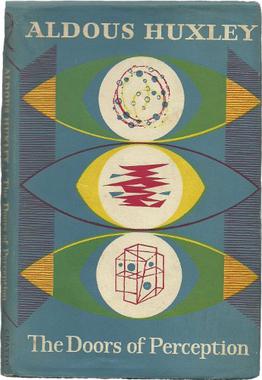
The Author and His Preparation
Aldous Leonard Huxley (1894--1963) was already one of the 20th century's most prominent literary intellectuals when he turned his attention to mescaline. Born into the British scientific aristocracy -- his grandfather was the biologist Thomas Henry Huxley, his brother Julian a founding director of UNESCO -- Aldous had published novels (Brave New World, 1932; Point Counter Point, 1928), essay collections, and philosophical works that established him as a leading public thinker on technology, society, and consciousness.
By the early 1950s, Huxley had emigrated to California and was deeply engaged with Eastern philosophy, particularly Vedanta. He had read accounts of mescaline experiments by Weir Mitchell, Havelock Ellis, and Heinrich Kluver, and he was corresponding with the British-Canadian psychiatrist Humphry Osmond, who was conducting clinical trials with mescaline at a Saskatchewan hospital.

The Experiment: May 4, 1953
On the morning of May 4, 1953, at his home in West Hollywood, Huxley ingested 400 milligrams of mescaline dissolved in water, administered by Osmond. Huxley's wife, Maria, was present, along with a researcher who took notes.
The experience, which lasted approximately eight hours, centered on visual perception. Huxley gazed at a small vase of flowers -- three roses, an iris, a carnation -- and was overwhelmed: "I was seeing what Adam had seen on the morning of his creation -- the miracle, moment by moment, of naked existence." He found that his normal conceptual filters had been removed. Objects were no longer merely useful things with names; they were presences radiating "is-ness" (a term he borrowed from the medieval philosopher Meister Eckhart's concept of Istigkeit).
He examined the folds of his trousers and saw in them a complexity and beauty comparable to the drapery in a painting by Botticelli. He walked in the garden and found that flowers seemed to be "glowing with their own inner light." He listened to music -- Josquin, Gesualdo, a recording of a Mozart piano concerto -- and experienced synesthetic blending of sound and color.
