
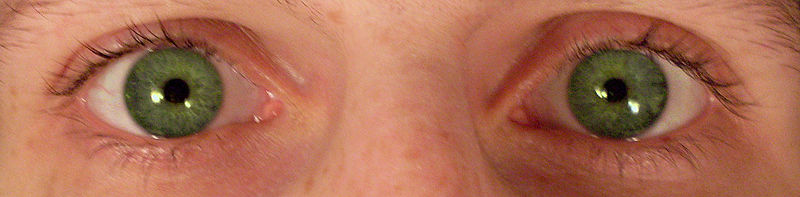
Constricted pupils, via Effect Index
Pupil constriction
A visible narrowing of the pupil diameter (miosis) that reduces the size of the dark center of the eye to a small pinpoint. This effect is one of the most reliable physical indicators of opioid intoxication and is often the first sign noticed by medical professionals and observers when assessing someone under the influence of opioids or certain other substance classes.
Description
Pupil constriction, clinically termed miosis, manifests as a visible and often dramatic narrowing of the pupils to a fraction of their normal resting diameter. Under normal lighting conditions, the resting pupil is typically 3-5mm in diameter; under strong opioid influence, it can constrict to 1-2mm or even less—tiny, almost imperceptible pinpoints that are strikingly obvious upon close inspection. From the user's perspective, the subjective experience is subtle: vision may seem slightly dimmer in low-light conditions due to reduced light entering the eye, and there may be a slight improvement in depth of focus (similar to the "pinhole effect" in optics), but most users are unaware of their miosis unless they look in a mirror or are told by others.
The degree of constriction is dose-dependent. At threshold opioid doses, a mild narrowing may be detectable only by careful measurement. At moderate doses, the pupils are noticeably smaller than normal—perhaps 2-3mm—and an attentive observer will notice the change. At strong doses, classic "pinpoint pupils" develop: 1-2mm in diameter, barely visible even in dim lighting, and unmistakable to anyone looking at the person's eyes. This extreme miosis persists even in dark environments where pupils would normally dilate, which is the distinguishing diagnostic feature.
The primary pharmacological mechanism involves opioid receptor activation of the Edinger-Westphal nucleus in the midbrain, which controls the parasympathetic innervation of the pupillary sphincter muscle via the oculomotor nerve. Mu-opioid receptor agonism stimulates this nucleus, causing sustained constriction of the iris sphincter. Unlike many opioid effects, miosis shows relatively little tolerance development—even chronic opioid users typically maintain constricted pupils, making it a reliable indicator regardless of tolerance status. Some cholinergic substances also produce miosis through direct parasympathomimetic action on the iris sphincter.
Beyond opioids, pupil constriction can be produced by cholinergic agonists (pilocarpine, nerve agents), some antipsychotic medications, clonidine (an alpha-2 adrenergic agonist), and certain organophosphate compounds. Among recreational substances, opioids are by far the most common cause. The constriction is bilateral and symmetric—unilateral miosis suggests a neurological rather than pharmacological cause. Notably, extremely high-dose opioid overdose can sometimes produce dilated rather than constricted pupils due to severe hypoxia affecting brain function, which can confuse assessment.
In clinical and forensic contexts, pinpoint pupils are one of the "opioid triad" signs alongside respiratory depression and altered consciousness. Emergency medical personnel use pupil size as a rapid assessment tool for opioid overdose. The persistence of miosis despite darkness is pathognomonic for opioid intoxication.
From a harm reduction standpoint, pupil constriction itself is not dangerous—it is purely a diagnostic sign. However, its presence reliably indicates opioid activity in the body, which means other, more dangerous effects (respiratory depression, sedation) are likely also present. If someone displays pinpoint pupils along with slow or shallow breathing and reduced consciousness, this constitutes a medical emergency requiring naloxone administration and emergency services. The degree of miosis can help observers gauge the level of opioid intoxication in someone who cannot communicate their state.
Intensity Levels
Level 1 — Threshold
20%Subtle pupil narrowing detectable only by careful comparison to normal size. No functional visual impact.
Level 2 — Light
40%Pupils are noticeably smaller than normal resting diameter. Attentive observers may comment. Slight dimming of vision in dark environments.
Level 3 — Moderate
60%Clearly constricted pupils at approximately 2-3mm. Obvious to observers. Reduced light entry may make dim environments harder to navigate.
Level 4 — Strong
80%Classic pinpoint pupils at 1-2mm. Unmistakable upon inspection. Pupils fail to dilate normally in darkness. A reliable indicator of significant opioid intoxication.
Level 5 — Overwhelming
100%Extreme miosis with pupils barely visible as tiny dots. Even in complete darkness, pupils remain pinpoint. Indicates very high levels of opioid receptor activation.
Safety & Danger Notes
Warning
While pupil constriction itself is harmless, it is a reliable indicator of opioid intoxication. Pinpoint pupils combined with slow breathing and reduced consciousness constitute the opioid overdose triad—a medical emergency requiring immediate naloxone and emergency services.