
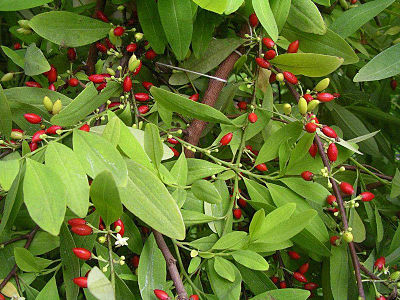
Group of plant varieties cultivated for coca and cocaine production
Coca refers to any of the four cultivated plants in the family Erythroxylaceae, native to western South America. It is known worldwide for its psychoactive alkaloid, cocaine. The leaves contain cocaine, which acts as a mild stimulant when chewed or consumed as tea; this traditional use involves slower absorption than purified cocaine, and there is no evidence of addiction or withdrawal symptoms from such natural consumption.
The coca plant is a shrub-like bush with curved branches, oval leaves marked by distinct curved lines, and small yellowish-white flowers that develop into red berries. Genomic analysis indicates coca was domesticated two or three separate times from the wild species Erythroxylum gracilipes by different South American groups during the Holocene. Chewing coca leaves dates back at least 8,000 years in South America, as evidenced by coca leaves and calcite found in house floors in Peru's Nanchoc Valley, suggesting early communal use alongside the rise of farming. Coca use was widespread under Inca rule. The Incas deeply integrated it into their society for labor, religion, and trade, valuing it so highly that they colonized new lands for its cultivation. Spanish colonizers later attempted to suppress its use, but ultimately relied on it to sustain enslaved laborers. Traditionally, across Andean cultures, coca leaves have been used for medicinal, nutritional, religious, and social purposes—serving as a stimulant, remedy for ailments, spiritual tool, and source of sustenance, primarily through chewing and tea.
Coca thrives in hot, humid environments and can be harvested multiple times a year from carefully tended plots. It is grown as a cash crop in the Argentine Northwest, Bolivia, the Alto Rio Negro Indigenous Territory in Brazil, Colombia, Venezuela, Ecuador, and Peru, including in areas where its cultivation is unlawful. There are some reports of cultivation in southern Mexico using seeds imported from South America, as an alternative to smuggling the processed drug cocaine. The plant plays a fundamental role in many traditional Amazonian and Andean cultures, as well as among indigenous groups in the Sierra Nevada de Santa Marta of northern Colombia.
Coca leaves are used commercially and industrially in teas, foods, cosmetics, and beverages. Their legal commercial use has growing political and market support in countries like Bolivia and Peru, despite restrictions in others like Colombia. The international prohibition of the coca leaf, established by the 1961 United Nations Single Convention—which did not distinguish it from cocaine despite traditional Andean uses—has been widely contested. Bolivia and Peru have led ongoing efforts to reevaluate its status, including a scheduled 2025 WHO review based on cultural and scientific grounds. Outside South America, coca leaf is generally illegal or heavily restricted, often treated similarly to cocaine. Limited exceptions exist for scientific or medical use, and for specific authorized imports such as the decocainized leaf extract used for Coca-Cola flavoring in the United States.
The cocaine alkaloid content in dry Erythroxylum coca var. coca leaves ranges from 0.23% to 0.96%. Coca-Cola used coca leaf extract in its products from 1885 until about 1903, when it switched to using a decocainized leaf extract. Extracting cocaine from coca requires several solvents and a chemical process known as an acid–base extraction, which can efficiently isolate the alkaloids from the plant material.
Safety at a Glance
High Risk- Toxicity: Traditional coca use carries extremely low toxicity compared to extracted cocaine. The slow, low-level absorption pre...
- Overdose risk: Limited specific overdose data is available for Coca. In the absence of compound-specific informa...
- Start with a low dose and wait for onset before redosing
- Test your substance with reagent kits when possible
If someone is in crisis, call 911 or Poison Control: 1-800-222-1222
Dosage
oral
Duration
oral
Total: 30 min – 2 hrsHow It Feels
The onset of coca leaf, whether chewed or brewed as tea, is gentle and ancient. Within five to ten minutes, a subtle numbness spreads through the gums and tongue -- the telltale signature of local anesthetic alkaloids working alongside cocaine itself. A mild stimulation begins to gather: a brightening of alertness, a gentle warming of the body, and a barely perceptible elevation of mood that feels as natural as the lift from a cup of good tea. The experience is so mild and so seamlessly integrated into ordinary consciousness that identifying its exact onset requires deliberate attention.
As the effects develop over the next fifteen to thirty minutes, coca reveals itself as the gentlest member of the stimulant family. There is a modest improvement in energy and endurance -- the traditional use for altitude sickness and physical labor becomes immediately comprehensible. The legs feel lighter on inclines. Breathing at altitude comes more easily. Hunger and fatigue are gently suppressed, not erased but simply rendered less insistent. The mood elevation is real but entirely natural in character: a quiet contentment, an appreciation for one's surroundings, and a mild sociability that facilitates conversation without altering its character. There is no euphoria, no rush, no sense of being chemically enhanced.
The physical experience is dominated by the numbing of the oral mucosa and a subtle warmth throughout the body. Heart rate may increase marginally. Gastrointestinal function seems to improve, and the traditional use as a digestive aid is supported by the sensation of comfort in the stomach. The stimulation is so mild that it does not interfere with normal activities or social interaction -- it enhances them without announcing its presence.
The effects of a single application last one to two hours and fade imperceptibly. There is no comedown, no crash, no craving. The experience simply returns to baseline, and the only indication that it has ended is the return of the mild fatigue or hunger that was gently held at bay. Coca leaf, in its natural form, represents stimulation at its most civilized and least harmful -- a profound contrast with the concentrated alkaloid that can be extracted from it, and a reminder that the relationship between a plant and its most potent chemical is never simple.
Subjective Effects
The effects listed below are based on the Subjective Effect Index (SEI), an open research literature based on anecdotal reports and personal analyses. They should be viewed with a healthy degree of skepticism. These effects will not necessarily occur in a predictable or reliable manner, although higher doses are more liable to induce the full spectrum of effects.
Physical Effects
Physical(3)
- Increased heart rate— A noticeable acceleration of heartbeat that can range from a subtle awareness of one's pulse to a fo...
- Stimulation— A state of heightened physical and mental energy characterized by increased wakefulness, elevated mo...
- Vasoconstriction— A narrowing of blood vessels throughout the body that produces sensations of cold extremities, tingl...
Pharmacology
Coca leaves contain approximately 0.5–1% cocaine alkaloid by dry weight, along with ecgonine methyl ester, cinnamoylcocaine, benzoylecgonine, and several other alkaloids. When leaves are chewed or prepared as tea (mate de coca), the bioavailability of cocaine is dramatically reduced compared to insufflated or smoked cocaine: chewing releases alkaloids slowly through buccal mucosa absorption, with peak blood levels roughly 1/100th those achieved by nasal insufflation of an equivalent dose. Total cocaine absorbed from a typical chewing session (20–40 g of leaves with lime/llipta as activating agent) is approximately 0.6–2.4 mg — far below pharmacologically significant doses for most effects.
At these trace levels, cocaine acts primarily as a local anesthetic (numbing the oral mucosa and throat) via sodium channel blockade. Any mild stimulant effects come partly from cocaine but also from the alkaloid methylecgonidine and possibly the leaf's flavonoids and volatile oils. The lime or bicarbonate catalyst (llipta in the Andes) alkalinizes the oral environment, freeing the cocaine from its salt form for better absorption through mucous membranes.
Coca tea provides even lower alkaloid exposure. Standardized tea bags contain approximately 4.9 mg of cocaine per bag, of which only a small fraction is absorbed. This is well below any stimulant threshold for most adults, though urine drug tests may detect benzoylecgonine (cocaine metabolite) for 24–36 hours after consumption.
Detection Methods
Urine Detection
Coca (Erythroxylum coca) leaves contain cocaine, along with other tropane alkaloids including ecgonine, cinnamoylcocaine, and truxilline. Chewing coca leaves or drinking coca tea will produce positive results on standard cocaine immunoassays. The urine detection window is 2 to 4 days following coca leaf consumption, as the immunoassay target is benzoylecgonine (the primary cocaine metabolite). Even small amounts of coca tea consumption can produce urine concentrations above standard cutoffs.
Blood and Serum Detection
Blood detection windows for cocaine from coca leaf use are approximately 6 to 24 hours. Benzoylecgonine persists longer, approximately 12 to 48 hours. Peak plasma concentrations from coca leaf chewing occur more slowly and at lower levels than from refined cocaine.
Standard Drug Panel Inclusion
Coca leaf consumption IS detected on standard 5-panel, 10-panel, and 12-panel drug screens. The cocaine metabolite benzoylecgonine is a standard immunoassay target. This is clinically significant for travelers to South America who consume coca tea. The standard immunoassay cutoff (150-300 ng/mL) can be exceeded by a single cup of coca tea.
Confirmatory Methods
GC-MS and LC-MS/MS confirm benzoylecgonine. Additional tropane alkaloids from coca leaves (ecgonine methyl ester, cinnamoylcocaine) may be detectable and could theoretically distinguish coca leaf use from refined cocaine, though this distinction is not routinely made.
Reagent Testing (Harm Reduction)
The Scott reagent (cobalt thiocyanate) is the standard field test for cocaine, producing a blue color. Coca leaves or coca tea can produce a positive Scott reaction depending on alkaloid concentration. The Marquis reagent shows no reaction with cocaine. The Mandelin reagent shows orange with cocaine.
Interactions
No documented interactions.
History
Coca cultivation dates back at least 8,000 years in the Andean region of South America, making it one of the oldest cultivated plants in the Western Hemisphere. Archaeological evidence from Peru documents coca use for ritual, medicinal, and nutritive purposes by pre-Inca cultures. The Inca Empire controlled coca cultivation and distribution, reserving its use largely for priests, nobility, and soldiers, before it was more widely democratized in colonial and post-colonial periods.
Spanish conquistadors initially attempted to suppress coca use as "an idol of the Devil," but reversed course when they observed that indigenous mine workers collapsed without it — coca was essential to sustaining the forced labor in silver mines like Potosí. European travelers brought coca to Europe in the 16th century, but the leaves degraded before they could be properly studied.
In 1860, German chemist Albert Niemann isolated cocaine from coca leaves — the first time the alkaloid had been extracted in pure form. This discovery launched the pharmaceutical cocaine era: Angelo Mariani's coca wine (Vin Mariani) became wildly popular in Europe (endorsed by Pope Leo XIII, US Presidents, and countless celebrities), and in 1886 John Pemberton included coca leaf extract in his original Coca-Cola formula. Sigmund Freud's 1884 essay Über Coca enthusiastically recommended cocaine as a treatment for morphine addiction, depression, and fatigue before cocaine's addictive properties became apparent.
By 1914 the Harrison Narcotics Tax Act in the US heavily restricted cocaine, and coca products were effectively banned. Coca-Cola continued using a "decocainized" coca leaf extract (retaining flavor compounds but not alkaloids), which it does to this day. In contemporary Andean countries, coca leaf remains culturally central, legally protected, and a subject of ongoing political tension with international drug control treaties.
Harm Reduction
Distinguish coca from cocaine. Traditional coca leaf use is pharmacologically and toxically distinct from cocaine use. The harm profile of chewing coca leaves more closely resembles drinking coffee than using cocaine.
Drug testing awareness. Consuming any coca product — including legal tea purchased in Andean countries — can produce a positive cocaine urine drug test for 24–48 hours. This is an important consideration for employment or legal drug screening.
Sourcing and legal status. Coca leaves are legal in Bolivia, Peru, and some other Andean countries but are a Schedule I controlled substance in the United States and illegal in most of Europe and Australia. Importing coca products to these countries is illegal even for traditional use. Be aware of local laws.
Altitude use context. In the Andes, coca is traditionally used to mitigate altitude sickness (soroche). While the evidence is modest, coca's mild stimulant, circulatory, and anorectic effects may provide genuine physiological benefit at high altitude. This is a traditional, community-embedded use context distinct from recreational stimulant use.
Not a gateway to cocaine. The pharmacological bridge from coca chewing to cocaine dependency is not supported by evidence from Andean populations. The slow, mild absorption does not produce the reinforcing dopamine spikes associated with cocaine's addictive potential.
Toxicity & Safety
Traditional coca use carries extremely low toxicity compared to extracted cocaine. The slow, low-level absorption prevents the acute cardiovascular effects (severe hypertension, tachycardia, vasoconstriction) and neurotoxic effects associated with cocaine abuse. No deaths attributable to traditional coca leaf use have been documented.
Long-term traditional users in Andean populations show no significant adverse effects from lifelong use. There is some concern about dental erosion from the acidic/alkaline chewing cycle and chronic gum contact, but this has not been systematically studied.
Important exception for drug testing: Coca products (leaves, tea, candy) will cause a positive cocaine urine drug test. This has resulted in false positives for individuals who consumed legal coca products — including tourists to Andean countries. Benzoylecgonine can be detectable for 24–48 hours after coca tea consumption.
Coca products should be avoided by: pregnant women (cocaine crosses the placenta even at low doses), those with cocaine sensitivity or cardiovascular conditions, and individuals subject to workplace or legal drug testing. Coca leaves combined with MAOIs may have unpredictable interactions given the multiple alkaloids present.
Overdose Information
Limited specific overdose data is available for Coca. In the absence of compound-specific information, general principles apply:
If someone exhibits signs of medical distress after using Coca — difficulty breathing, severe confusion, seizures, chest pain, extremely elevated temperature, or loss of consciousness — treat it as a medical emergency. Call emergency services and be forthcoming about what was consumed. Medical professionals follow confidentiality protocols and their priority is saving lives.
Prevention remains the best approach: use the minimum effective dose, avoid combining with other substances, and always have a sober person present who can recognize signs of distress and call for help.
Tolerance
| Full | Develops with prolonged and repeated use |
| Half | 3 - 7 days |
| Zero | 1 - 2 weeks |
Cross-tolerances
Legal Status
The legal status of Coca varies by jurisdiction and is subject to change. This information is provided for educational purposes and may not reflect the most current legislation.
General patterns: Many psychoactive substances are controlled under national and international drug control frameworks, including the United Nations Single Convention on Narcotic Drugs (1961), the Convention on Psychotropic Substances (1971), and country-specific legislation such as the US Controlled Substances Act, UK Misuse of Drugs Act, and EU Framework Decisions.
Research chemicals and analogues: Novel psychoactive substances may be captured by analogue laws (e.g., the US Federal Analogue Act) or blanket bans on substance classes (e.g., the UK Psychoactive Substances Act 2016), even if the specific compound is not individually scheduled.
Important note: Possessing, distributing, or manufacturing controlled substances carries serious legal consequences in most jurisdictions. Legal status is not a reliable indicator of a substance's safety profile — some highly dangerous substances are legal, while some with favorable safety profiles are strictly controlled.
Users are strongly encouraged to research the specific legal status of Coca in their jurisdiction before any involvement with this substance.
Experience Reports (2)
Tips (5)
Keep a usage log for Coca including dose, time, effects, and side effects. This helps you identify patterns and prevent problematic escalation.
Coca leaf contains many alkaloids beyond cocaine, including ecgonine and various vitamins and minerals. The traditional use of coca by indigenous peoples is not equivalent to cocaine use. The chewing process releases alkaloids slowly over hours, producing gradual mild stimulation without the rush-crash cycle of cocaine.
Coca leaves and coca tea are illegal in most countries outside of South America, even though they contain only minute amounts of cocaine. Possession can result in the same legal penalties as cocaine in some jurisdictions. Be aware of local laws before purchasing or transporting.
Coca leaf tea is a traditional remedy for altitude sickness in South America and contains only trace amounts of cocaine alkaloids. Chewing coca leaves or drinking mate de coca is a very different experience from refined cocaine, producing mild stimulation similar to a cup of coffee.
Research potential interactions before combining Coca with other substances. Drug interactions can be unpredictable and dangerous.
Community Discussions (1)
See Also
References (3)
- PubChem: Coca
PubChem compound page for Coca (CID: 446220)
pubchem - Coca - TripSit Factsheet
TripSit factsheet for Coca
tripsit - Coca - Wikipedia
Wikipedia article on Coca
wikipedia