
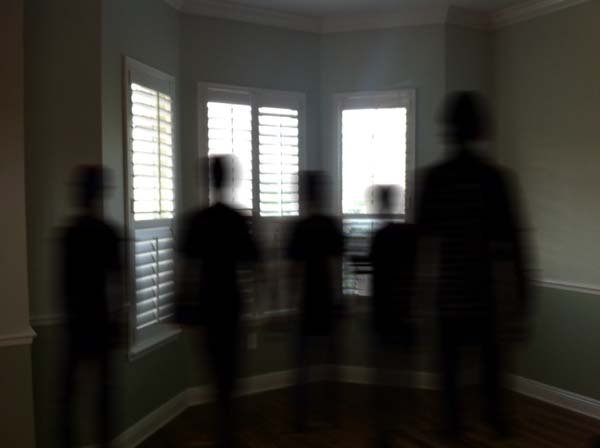
Shadow group, via Effect Index
Shadow people
The perception of dark, humanoid silhouettes lurking in peripheral vision or standing in direct line of sight, appearing to move and behave as autonomous, sentient beings. These entities feel disturbingly real and are a hallmark of deliriant intoxication and sleep deprivation.
Description
Shadow people are the experience of perceiving patches of shadow in one's peripheral or direct line of sight that appear and behave as living, autonomous beings. These dark, humanoid silhouettes seem to lurk at the edges of vision, peer around corners, stand motionless in doorways, or move across rooms with purposeful intent. Unlike many hallucinatory phenomena that are recognized as unreal even while they are occurring, shadow people often carry an intense and visceral sense of presence — the conviction that something is genuinely there, watching from the darkness.
The appearance of shadow people varies but typically conforms to certain patterns. They most commonly manifest as featureless dark humanoid shapes, roughly human in proportions but lacking distinguishable features such as faces, clothing, or limbs. Some appear as tall, thin silhouettes; others as crouching or hunched figures. In some reports, they wear hats or hooded garments, and a recurring archetype known as the "Hat Man" — a tall shadow figure wearing a wide-brimmed hat or fedora — appears across numerous independent reports from different individuals and cultural backgrounds, suggesting a possible neurological basis for this specific form.
Shadow people are most commonly induced under the influence of heavy dosages of deliriant compounds such as diphenhydramine (DPH), datura, and benzydamine. They are also a characteristic phenomenon of stimulant psychosis resulting from extended use of substances like methamphetamine or cocaine, and they are a well-documented feature of severe sleep deprivation, typically emerging after 48 to 72 or more hours without sleep. They can also occur during sleep paralysis, a state in which the brain partially activates dream-generating mechanisms while the person remains conscious.
The emotional response to shadow people is almost universally negative, ranging from mild unease to profound terror. They are frequently accompanied by coinciding effects such as delirium, paranoia, anxiety, and a pervasive feeling of impending doom — a sense that something terrible is about to happen. The combination of realistic-seeming humanoid figures and the anxiogenic pharmacological profiles of the substances that produce them creates experiences that many users describe as genuinely frightening in a way that other hallucinations are not.
Unlike the hallucinations produced by classical psychedelics, which are typically recognized as drug-induced and often appreciated for their aesthetic qualities, shadow people integrate seamlessly into waking perception in a manner that makes them extremely difficult to distinguish from reality. This realistic quality is characteristic of deliriant hallucinations in general, which tend to produce solid, convincing perceptions that the user may interact with as if they were real objects or beings. The shadow person may appear to react to the user's movements, withdraw when approached, or seem to communicate menacing intent through body language alone.
It is important to note that the prevalence of shadow people across diverse contexts — deliriants, stimulant psychosis, sleep deprivation, and sleep paralysis — suggests that they may represent a fundamental pattern that the human visual system defaults to when operating under extreme stress or pharmacological disruption. The brain's tendency to interpret ambiguous visual information as human figures (pareidolia) likely contributes to this effect, with degraded or noisy visual processing generating false positives for the detection of human-shaped forms.
Intensity Levels
Level 1 — Threshold
25%Brief, fleeting impressions of dark shapes moving in peripheral vision that disappear when looked at directly. Easily dismissed as tricks of the light, though they may create a subtle sense of unease.
Level 2 — Mild
50%Dark humanoid silhouettes become visible in peripheral vision with greater frequency and persistence. They may linger for several seconds before fading. A growing sense of being watched or not being alone develops.
Level 3 — Moderate
75%Shadow figures are clearly visible and may appear in direct line of sight rather than just peripherally. They exhibit apparent autonomous behavior — moving, lurking, or peering around objects. The sense of their presence is convincing and unsettling.
Level 4 — Strong
100%Multiple fully formed shadow entities populate the environment, moving with apparent purpose and seeming to interact with the user and each other. They feel overwhelmingly real and present, and the experience is typically accompanied by intense paranoia and dread.