
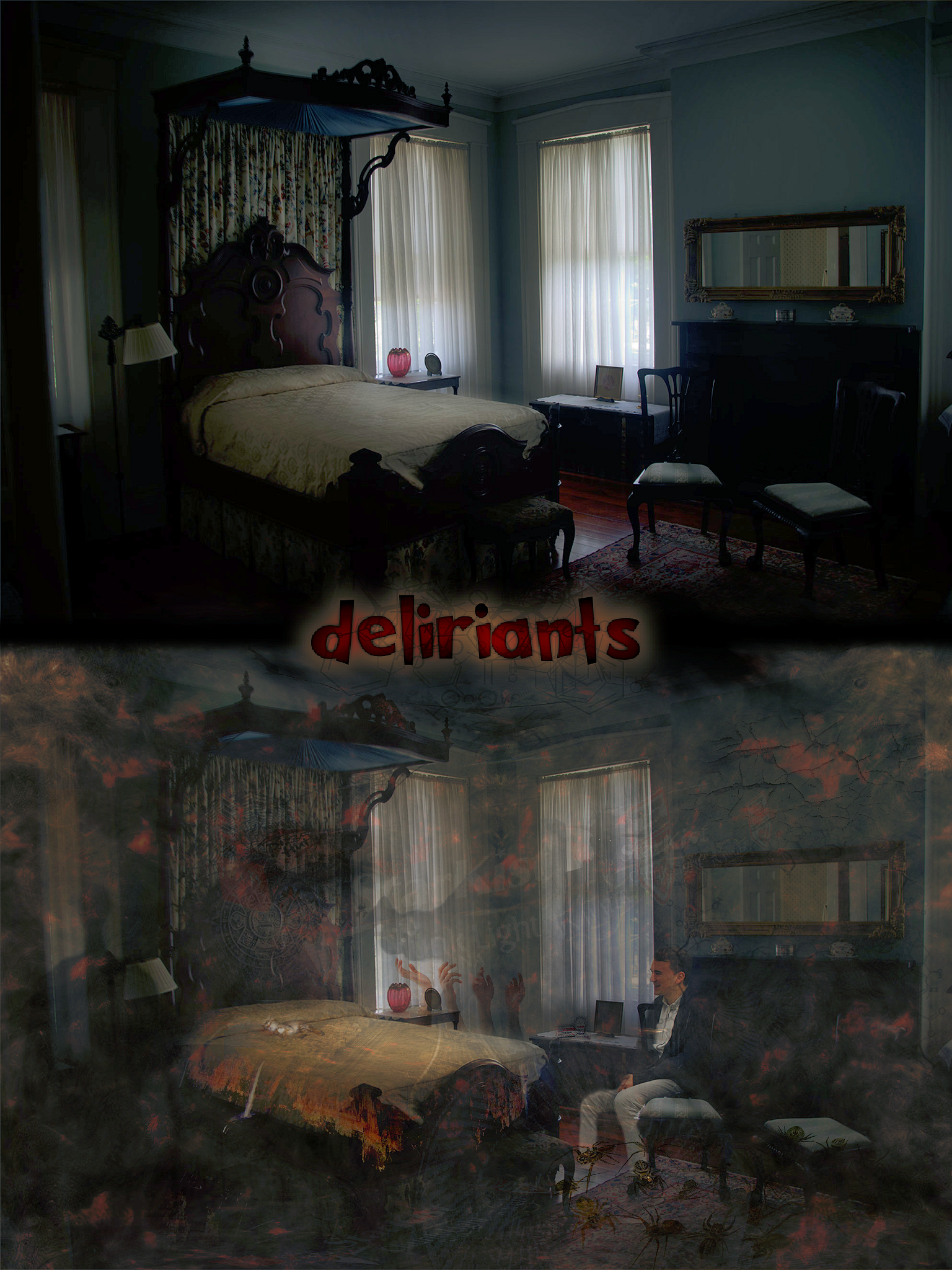
700mg of DPH by Stas Constantine, via Effect Index
External hallucination
A visual hallucination that manifests within the external environment as though it were physically real, ranging from subtle distortions of existing objects to fully autonomous, detailed scenes and entities that appear indistinguishable from reality.
Description
External hallucinations represent the most vivid and reality-disrupting category of visual effects — fully formed perceptual experiences that project seamlessly into the observer's physical environment as though they are genuinely, physically present. Unlike internal hallucinations (which require closed eyes and occur within an imagined mental space), external hallucinations are perceived with eyes open and appear to occupy real three-dimensional space alongside genuine objects and people. At their most intense, they can be completely indistinguishable from reality.
The effect progresses through recognizable stages of intensity. At lower levels, external hallucinations may manifest as minor additions or modifications to existing objects — faces might appear in textures, shadows might seem to move with purpose, or peripheral objects might briefly take on unfamiliar forms before "correcting" themselves when examined directly. At moderate levels, distinct hallucinatory elements appear within the environment: small creatures, geometric objects, or human figures that are translucent or somewhat ghostly but clearly present. At the highest levels, elaborate, fully detailed scenes — populated environments, autonomous beings, even entire narrative sequences — unfold within the physical space, rendering the boundary between hallucination and reality virtually impossible to determine.
Environmental factors dramatically influence both the likelihood and detail level of external hallucinations. Dim lighting substantially increases their frequency and intensity, as reduced visual input gives the brain more latitude to generate hallucinatory content.Cluttered environments with many objects and textures provide more substrate for hallucinations to "grow" from.Unfamiliar settings increase the probability because the brain has fewer stored expectations to correct against. Conversely, bright, well-lit, sparse environments tend to suppress the effect, though hallucinations that do appear under these conditions may be rendered with remarkable detail.
The emotional state of the observer profoundly shapes hallucinatory content. Those in a positive, stable mindset tend to encounter neutral or fascinating imagery — curious creatures, beautiful environments, or benign autonomous entities. Those in anegative or anxious state are far more likely to encounter disturbing content — threatening figures, sinister scenarios, or imagery drawn directly from personal fears. This emotional dependency makes set and setting particularly critical for substances that reliably produce external hallucinations.
External hallucinations are most commonly associated with high doses of deliriants (diphenhydramine, datura, benzydamine), where they are a defining feature and are characteristically mistaken for reality. They also occur with high-dosepsychedelics,dissociatives, duringstimulant psychosis, and following severesleep deprivation. The deliriant form is generally considered the most dangerous because the loss of reality-testing means the individual may interact with hallucinated objects and entities as though they were real.
Intensity Levels
Fleeting hallucinations
25%At the lowest level, external hallucinations generally consist of movement within the peripheral vision and ill-defined, fleeting hallucinations that disappear once a person double takes.
Vaguely defined hallucinations
50%At this level, the hallucinations are visible within one's direct line of sight, but are not fully defined in their appearance. This means that, although visible, they do not look completely detailed and are often extremely blurry or semi-translucent with little to no colour.
Partially defined hallucinations
75%At this level, the hallucinations become distinct enough in their detail and vividness to extend beyond transparent, colourless, or blurry manifestations. However, they still remain unconvincing and do not quite live up to the detail of everyday life.
Fully defined hallucinations
100%At this level, the hallucinations have become completely realistic and will rarely disappear due to a double take. They are now capable of a completely convincing and photorealistic appearance and their behaviour becomes far more lifelike. Additionally, they may become numerous enough to fully engulf the entirety of the person's environment.