
White wolf drinking water, via Effect Index
Visual disconnection
A dissociative visual effect involving a progressive detachment from visual perception, ranging from minor suppression and blurring at lower levels to a complete perceptual blackout and immersion in a dark hallucinatory void at higher levels.
Description
Visual disconnection is the experience of becoming progressively distanced and detached from one's own sense of sight. It sits at the intersection of visual suppression and dissociative phenomenology — rather than vision becoming distorted or enhanced, it is gradually withdrawn, as though the connection between the eyes and conscious awareness is being systematically severed. The result is a spectrum of effects that progresses from mild visual impairment to a state of complete perceptual blindness.
At its lower levels, visual disconnection manifests as a constellation of related suppressive effects. Vision may become blurry, doubled, or sluggish in its frame rate. The ability to mentally process and interpret visual information degrades (a state closely related to visual agnosia). Colors may appear washed out. The overall impression is of vision becoming "distant" — still technically functional but no longer feeling like a direct, immediate connection to the external world. Users often describe this as looking at the world through progressively thicker glass, or as though their visual feed is being transmitted from a remote camera with increasing latency.
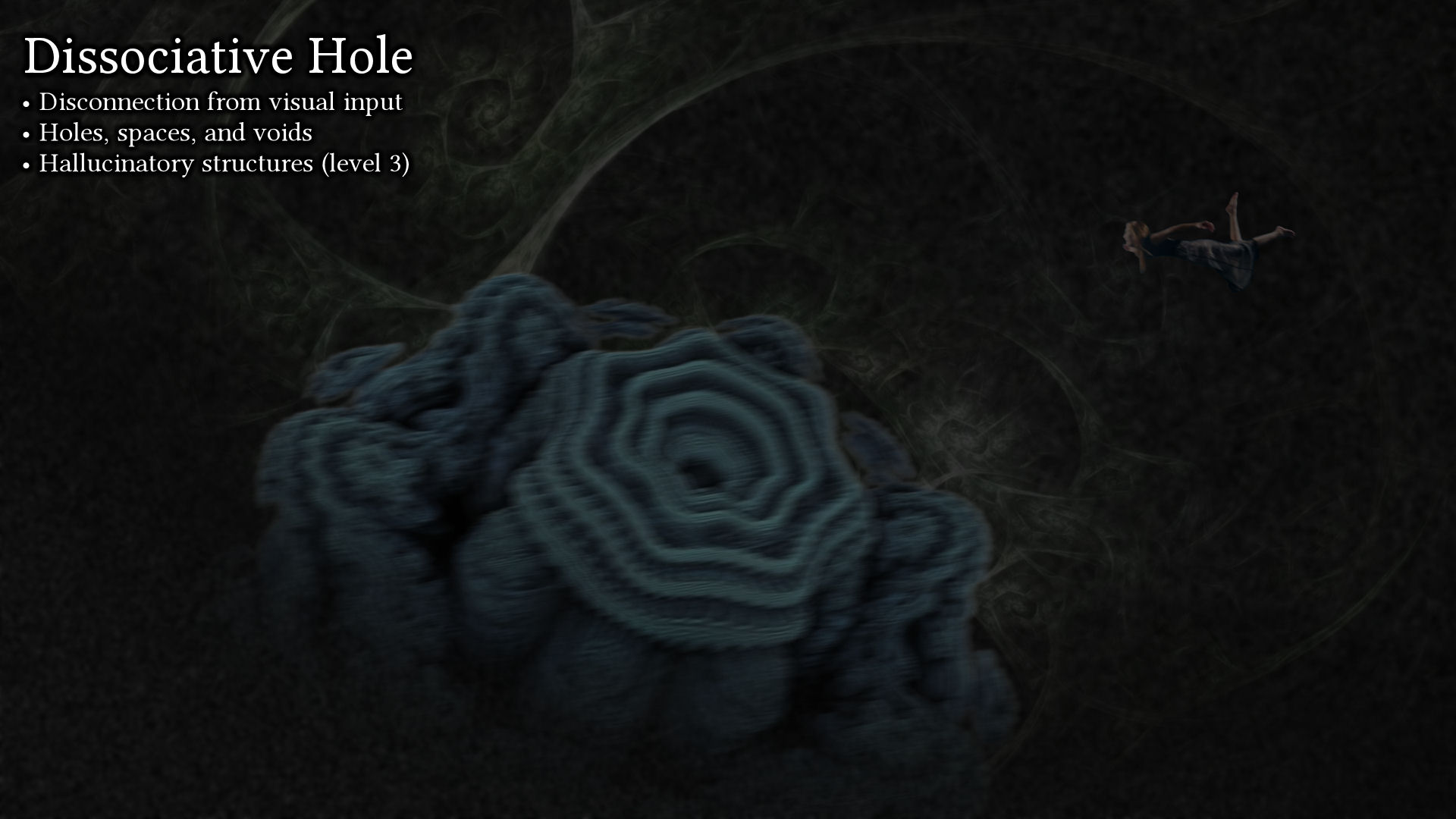
At higher intensities, the disconnection becomes all-encompassing. Visual input may be reduced to vague blobs of light and shadow, and eventually the distinction between open and closed eyes disappears entirely. The individual can no longer tell whether they are seeing anything at all. This state represents a complete perceptual disconnection from the sense of sight, and it is at this threshold that many users report finding themselves immersed in what is commonly known as a "hole" — a dark, expansive hallucinatory void that feels as though it exists outside of normal physical reality. The most famous example is theketamine "K-hole", though this phenomenon occurs with other dissociatives as well.
Visual disconnection is a near-universal effect at moderate to high doses of dissociative compounds such as ketamine, PCP, DXM, and methoxetamine. It typically progresses alongsidecognitive disconnection andphysical disconnection, creating a comprehensive detachment from all aspects of ordinary sensory experience. The effect is strongly dose-dependent and is generally reversible upon the substance wearing off, though the experience of complete visual blackout and void-immersion can be profoundly disorienting and existentially challenging.
Harm reduction note: Complete visual disconnection renders a person functionally blind and unable to navigate their environment. This creates significant fall risk and vulnerability. Anyone using dissociatives at doses that may produce this effect should be seated or lying down in a safe, supervised environment before the onset.
Intensity Levels
2-dimensional structures
25%At the lowest level, structures confine their form to strictly 2-Dimensional shapes. These shapes are usually flat and dark in their colour. Their presence is also often “felt” instead of seen. In terms of their size, these structures usually take up the entirety of a person's visual field but do not appear to have any particular sense of size attributed to them.
Partially defined 3-dimensional structures
50%At this level, the structures become better defined and 3-dimensional in shape with some basic detail to their lighting and shadows. They appear to be comprised of semi-transparent condensed colour and are seen as ill-defined or out of focus around their edges. In terms of size, these structures appear to be extremely large, stretching out up to seemingly hundreds of meters.
Fully defined 3-dimensional structures
75%At this level, structures become fully defined in their shape, edges, lighting, shadow, and detail. They often appear to be made of solid and dense realistic materials such as stone and metal. In terms of their size, they are capable of appearing as thousands of miles long and are often extremely complex in terms of their shape and texture.
Structural machine-universes
100%At its highest level, hallucinatory structures can be described as the sensation of seeing that which is subjectively perceived as the entire universe condensed into an infinitely vast and intricate ever-shifting machine structure. In terms of its appearance, this state is extremely hard to describe but has many subjective similarities to level 8A geometry. The structure can take any form, but usually appear as intricately shaped machine-like structures that are seemingly infinite in size and can convey huge amounts of innately understandable information. This experience is not just perceived through one's sense of sight but is also physically felt in an incomprehensible level of detail that manifests itself as complex cognitive and tactile sensations. The structure as a whole and the information it conveys are often innately interpreted as perceiving a structural representation of “the universe” or “everything”.