
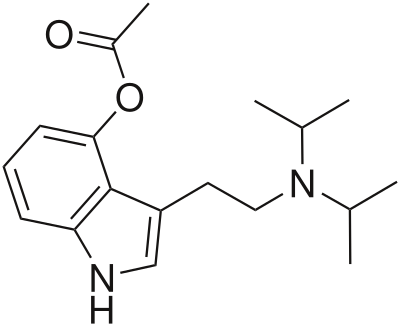
4-AcO-DiPT (4-acetoxy-N,N-diisopropyltryptamine), also known as iprocetyl or 4-acetoxy-DiPT, is a synthetic psychedelic tryptamine and acetylated prodrug analog of 4-HO-DiPT (iprocin). It belongs to the same structural family as psilocybin but substitutes two isopropyl groups on the terminal amine rather than two methyl groups. The compound was first synthesized and documented by Alexander Shulgin and Ann Shulgin, with their research recorded in the 1997 book TiHKAL: Tryptamines I Have Known and Loved.
4-AcO-DiPT is considered by many experienced tryptamine users to have a notably distinct character within the psychedelic tryptamine class. Community reports and Shulgin's own documentation describe an experience that is more physical, erotic, and sensory than the archetypal psilocybin-like 4-AcO-DMT — with less pronounced visual geometry but heightened tactile and bodily sensation, euphoria, and sensory enhancement. Users frequently note a particularly pronounced effect on music perception and a warm, stimulating quality. Duration is relatively short — typically 3–4 hours — making it one of the briefer full-spectrum psychedelic tryptamines.
The name "iprocin" for its active form (4-HO-DiPT) alludes to the isopropyl substitution pattern. Unlike the DMT analog 4-AcO-DMT, which is widely available and well documented, 4-AcO-DiPT is considerably more obscure in the research chemical market, though it maintains a following among tryptamine connoisseurs for its distinctive profile.
Safety at a Glance
High Risk- AcO-DiPT is less commonly available than 4-AcO-DMT. Test with Ehrlich reagent (positive for indole tryptamines: purpl...
- Threshold: 5 mg | Low: 10–15 mg | Common: 15–25 mg | Strong: 25–35 mg
- Toxicity: Acute Toxicity No formal human toxicological data exists. Based on structural class membership (substituted 4-hydroxy...
- Overdose risk: Fatal overdose from 4-AcO-DiPT alone, at doses within the typical recreational range, is extremel...
If someone is in crisis, call 911 or Poison Control: 1-800-222-1222
Dosage
oral
Duration
oral
Total: 3 hrs – 4 hrsHow It Feels
The onset of 4-AcO-DiPT announces itself through the ears before the eyes. Within thirty to forty-five minutes of ingestion, a subtle shift in auditory perception begins — a faint metallic quality creeps into familiar sounds, as though they are being played through a slightly warped speaker. Voices acquire an unusual resonance, and ambient noise takes on a layered, almost musical structure. Concurrently, a mild body buzz emerges, concentrated in the torso and hands, accompanied by a light-headed spaciness that is neither pleasant nor unpleasant but distinctly strange.
As the experience deepens, the auditory effects become the defining feature. Pitch shifts begin: voices drop or rise by a semitone or two, music starts to sound slightly off-key in ways that are simultaneously disorienting and fascinating. Familiar songs become alien compositions, their melodies recognizable but transformed, as though being performed by entirely different instruments in a slightly different tuning system. Conversations take on a surreal quality — the words are comprehensible, but they arrive with an unfamiliar timbre, making even intimate voices sound as though they belong to strangers. Visually, the effects are moderate: soft color enhancement, gentle surface breathing, and occasional tracers behind moving objects, but the visual dimension plays second fiddle to what is happening in the auditory landscape.
The peak arrives around ninety minutes to two hours in and holds for roughly two to three hours. The body load can be significant — a heavy, somewhat uncomfortable pressure in the chest and stomach, accompanied by vasoconstriction that leaves the extremities cold. Temperature regulation becomes erratic; waves of warmth alternate with sudden chills. The headspace is introspective but can be difficult to navigate, as the persistent auditory distortion creates an undercurrent of strangeness that colors every thought. Some find this dissonance fascinating and thought-provoking; others find it unsettling, particularly when trying to communicate.
Coming down, the auditory distortions gradually fade, the last to leave being that faint metallic sheen on voices. The body relaxes, the cold extremities warm, and a drowsy calm replaces the tension of the peak. The overall experience leaves behind a peculiar sense of having heard the world from a vantage point that does not normally exist — as though the usual frequency at which reality broadcasts had been briefly shifted to an adjacent channel.
Subjective Effects
The effects listed below are based on the Subjective Effect Index (SEI), an open research literature based on anecdotal reports and personal analyses. They should be viewed with a healthy degree of skepticism. These effects will not necessarily occur in a predictable or reliable manner, although higher doses are more liable to induce the full spectrum of effects.
Physical Effects
Physical(18)
- Body load— A diffuse, heavy physical discomfort involving tension, pressure, and malaise in the torso and limbs...
- Changes in felt bodily form— Changes in felt bodily form is the experience of one's body feeling as though it has altered its phy...
- Excessive yawning— Involuntary, repeated yawning that occurs far more frequently than normal and often without the usua...
- Increased bodily temperature— Increased bodily temperature (hyperthermia) is an elevation of core body temperature above the norma...
- Increased heart rate— A noticeable acceleration of heartbeat that can range from a subtle awareness of one's pulse to a fo...
- Increased libido— A marked enhancement of sexual desire, arousal, and sensitivity to erotic stimuli that can range fro...
- Muscle relaxation— The experience of muscles throughout the body losing their rigidity and tension, becoming noticeably...
- Nausea— An uncomfortable sensation of queasiness and stomach discomfort that may or may not lead to vomiting...
- Perception of bodily lightness— Perception of bodily lightness is the subjective feeling that one's body has become dramatically lig...
- Physical euphoria— An intensely pleasurable bodily sensation that can manifest as waves of warmth, tingling electricity...
- Physical fatigue— Physical fatigue is a state of bodily exhaustion characterized by reduced energy, diminished capacit...
- Pupil dilation— A visible enlargement of the pupil diameter (mydriasis) that can range from subtle widening to drama...
- Sedation— A state of deep physical and mental calming that manifests as a progressive desire to remain still, ...
- Seizure— Uncontrolled brain electrical activity causing convulsions and loss of consciousness -- a life-threa...
- Stimulation— A state of heightened physical and mental energy characterized by increased wakefulness, elevated mo...
- Temperature regulation disruption— Impaired thermoregulation causing unpredictable fluctuations between feeling hot and cold, with risk...
- Vasoconstriction— A narrowing of blood vessels throughout the body that produces sensations of cold extremities, tingl...
- Watery eyes— Excessive tear production causing overflow tearing and blurred vision, commonly occurring during opi...
Tactile(1)
- Tactile enhancement— The sense of touch becomes dramatically heightened, making physical contact feel intensely pleasurab...
Cognitive & Perceptual Effects
Visual(6)
- Colour enhancement— An intensification of the brightness, vividness, and saturation of colors in the external environmen...
- Colour shifting— The visual experience of colors on objects and surfaces cycling through continuous, fluid transforma...
- Drifting— The visual experience of perceiving stationary objects, textures, and surfaces as appearing to flow,...
- Geometry— The experience of perceiving complex, ever-shifting geometric patterns superimposed over the visual ...
- Tracers— Moving objects leave visible trails of varying length and opacity behind them, similar to long-expos...
- Visual acuity enhancement— Vision becomes sharper and more defined than normal, as though a slightly blurry lens has been broug...
Cognitive(11)
- Anxiety— Intense feelings of apprehension, worry, and dread that can range from a subtle background unease to...
- Anxiety suppression— A partial to complete suppression of anxiety and general unease, producing a calm, relaxed mental st...
- Compulsive redosing— An overwhelming, difficult-to-resist urge to continuously take more of a substance in order to maint...
- Disinhibition— A marked reduction in social inhibitions, self-consciousness, and behavioral restraint that manifest...
- Immersion enhancement— A heightened capacity to become fully absorbed and engrossed in external media such as music, films,...
- Introspection— An enhanced state of self-reflective awareness in which one feels drawn to examine their own thought...
- Mindfulness— Mindfulness in the substance context refers to a state of heightened present-moment awareness in whi...
- Music appreciation enhancement— A profound enhancement of one's enjoyment and emotional connection to music, making songs feel deepl...
- Novelty enhancement— A feeling of increased fascination, awe, and childlike wonder attributed to everyday concepts, objec...
- Psychosis— Psychosis is a serious psychiatric state involving a fundamental break from consensus reality — char...
- Time distortion— Subjective perception of time becomes dramatically altered — minutes may feel like hours, or hours p...
Auditory(2)
- Auditory distortion— Auditory distortion is the experience of sounds becoming warped, pitch-shifted, flanged, or otherwis...
- Auditory misinterpretation— Auditory misinterpretation is the brief, spontaneous misidentification of real sounds as entirely di...
Pharmacology
Prodrug Hydrolysis
4-AcO-DiPT is metabolically converted to 4-HO-DiPT (iprocin) through esterase-mediated hydrolysis of the acetyl group. This conversion is presumed to occur primarily in the blood via serum esterases and in the liver. The acetylation improves lipophilicity and facilitates absorption, while the active effects are primarily — if not exclusively — mediated by the 4-HO-DiPT metabolite.
5-HT2A Agonism
4-HO-DiPT acts as a partial agonist at serotonin 5-HT2A receptors, the primary target underlying psychedelic effects. The bulky diisopropylamino substitution pattern is hypothesized to influence the binding geometry at serotonin receptors in ways that contribute to the compound's distinctive subjective profile relative to other 4-HO tryptamines. Specifically, the larger N-alkyl groups may reduce intrinsic efficacy at 5-HT2A relative to smaller analogs, or differentially activate receptor signaling pathways.
The prominent bodily and sensory effects may reflect proportionally greater activity at non-5-HT2A targets, including 5-HT1A (bodily warmth, anxiolysis) and potentially sigma receptors, though this is speculative in the absence of comprehensive receptor binding data for 4-HO-DiPT.
Pharmacokinetics
The diisopropylamino substitution pattern slows metabolic degradation compared to dimethyl analogs. 4-HO-DiPT and its prodrug form are presumed to undergo hepatic metabolism. Onset after oral administration: 30–60 minutes. Peak: 1.5–2.5 hours. Total duration: 3–5 hours — notably shorter than psilocin or 4-HO-DMT analogs, which may reflect the steric bulk hindering receptor residence time.
The Short Duration Profile
The relatively brief duration of DiPT analogs is a pharmacologically interesting feature hypothesized to relate to the steric effects of the isopropyl groups on metabolic enzymes or receptor kinetics, though the precise mechanism has not been formally established.
Detection Methods
Urine Detection
4-AcO-DiPT is not targeted by standard immunoassay-based urine drug screens. As a prodrug, 4-AcO-DiPT is rapidly hydrolyzed in vivo to its corresponding 4-HO (psilocin-type) metabolite, and it is primarily this metabolite that would be detected in biological specimens. Specialized LC-MS/MS methods can detect 4-substituted tryptamine metabolites in urine for approximately 24 to 48 hours after ingestion. The detection window is relatively short compared to many other drug classes due to the rapid hepatic metabolism and renal clearance of tryptamine compounds. Psilocin (4-HO-DMT) is the most commonly targeted analyte in specialized tryptamine panels, and structural analogs may or may not be captured depending on the specific method.
Blood and Serum Detection
Blood detection windows for 4-AcO-DiPT are short, typically 4 to 12 hours after oral ingestion. Peak plasma concentrations of the active metabolite occur within 1 to 2 hours. The rapid first-pass metabolism means that parent compound concentrations in blood are often negligible for 4-AcO prodrugs, while 4-HO compounds themselves are measured directly. LC-MS/MS is required for reliable serum detection at the low concentrations involved.
Standard Drug Panel Inclusion
4-AcO-DiPT is NOT included on standard 5-panel, 10-panel, or 12-panel drug screens. Tryptamines do not cross-react with immunoassay targets for any of the standard panel analytes (amphetamines, cannabinoids, cocaine metabolites, opiates, PCP, benzodiazepines, or barbiturates). Detection requires a specific request for tryptamine or novel psychoactive substance testing at a reference laboratory. Some extended forensic panels include psilocin, which may capture certain 4-substituted tryptamines, but this coverage is not guaranteed for all structural variants.
Confirmatory Methods
Confirmatory identification of 4-AcO-DiPT relies on LC-MS/MS with reference standards specific to the compound or its expected metabolites. GC-MS can also be used following appropriate derivatization. Immunoassay-based methods for psilocybin and psilocin exist but show variable cross-reactivity with structural analogs and are not considered reliable for novel 4-substituted tryptamines. Reference laboratories specializing in novel psychoactive substances offer the most comprehensive detection capabilities.
Reagent Testing (Harm Reduction)
The Ehrlich reagent is the primary harm reduction tool for 4-AcO-DiPT. A sample placed on the reagent should produce a purple to violet color change, confirming the presence of an indole ring system characteristic of tryptamines. This reaction is shared with LSD, psilocybin, DMT, and all indole-containing compounds, so it confirms the general class but not the specific identity. The Hofmann reagent provides a confirmatory blue to violet reaction for tryptamines. The Marquis reagent typically shows no reaction or a dark brown discoloration with 4-substituted tryptamines. A positive Ehrlich result significantly reduces the probability that the substance is a dangerous substitute such as an NBOMe compound.
Interactions
| Substance | Status | Note |
|---|---|---|
| 3-FMA | Caution | Increases anxiety, cardiovascular stress, and psychological intensity |
| 4-MMC | Caution | Increases anxiety, cardiovascular stress, and psychological intensity |
| 8-Chlorotheophylline | Caution | Increases anxiety, cardiovascular stress, and psychological intensity |
| Adrafinil | Caution | Increases anxiety, cardiovascular stress, and psychological intensity |
| Anandamide | Caution | Cannabis can unpredictably intensify psychedelic effects and increase anxiety |
| Cannabis | Uncertain | — |
| 1,3-Butanediol | Low Risk & Synergy | Cross-tolerance exists; effects compound |
| 25E-NBOH | Low Risk & Synergy | Cross-tolerance exists; effects compound |
| 2C-T | Low Risk & Synergy | Cross-tolerance exists; effects compound |
| 2C-T-2 | Low Risk & Synergy | Cross-tolerance exists; effects compound |
History
Shulgin Documentation
4-AcO-DiPT's history is intimately tied to Alexander Shulgin's systematic investigation of tryptamine pharmacology. Shulgin synthesized and personally evaluated a vast number of N,N-dialkyl tryptamine variants, documenting their subjective effects in TiHKAL (1997). His account of DiPT (N,N-diisopropyltryptamine) is particularly notable — Shulgin described dramatic distortion of auditory perception as a primary effect, with sounds appearing transposed in pitch. The 4-HO and 4-AcO derivatives appear to shift the primary effects toward the somatosensory realm while retaining some of this character.
Research Chemical Market
Following TiHKAL's publication and the growth of online psychedelic communities in the early 2000s, 4-AcO-DiPT became available through research chemical vendors. It has maintained a niche but dedicated following among tryptamine enthusiasts who value its distinctive profile.
Contemporary Status
4-AcO-DiPT remains a relatively obscure compound even within the research chemical community. It is not explicitly scheduled in most jurisdictions, though it falls under analogue act provisions in the United States. No clinical research has specifically examined 4-AcO-DiPT or its active metabolite 4-HO-DiPT (iprocin), and the compound's pharmacological characterization remains largely dependent on Shulgin's original documentation and community experience reports.
Harm Reduction
Obtain and Test
4-AcO-DiPT is less commonly available than 4-AcO-DMT. Test with Ehrlich reagent (positive for indole tryptamines: purple/violet). Purchase from reputable sources with quality testing documentation.
Dosing
- Threshold: 5 mg |Low: 10–15 mg |Common: 15–25 mg |Strong: 25–35 mg
- Shulgin's active range was documented as approximately 10–20 mg. Start at 10 mg for first experiences.
- Weigh on a milligram-accurate scale.
- The shorter duration (3–4 hours) is useful for scheduling but can create a temptation to redose. Wait for full resolution before considering any supplemental dose.
Manage the Onset
Nausea during the onset phase (30–60 minutes) is relatively common. Consider dosing on an empty stomach and remaining still or lying down during the onset to reduce nausea. Ginger supplements may help some users.
Setting Considerations
Given 4-AcO-DiPT's distinctly physical and sensory character, the physical environment has outsized importance. Comfortable furnishings, pleasant tactile materials, access to music (the music enhancement is frequently described as exceptional), and temperature control are worth prioritizing.
Duration and Planning
The shorter 3–5 hour duration makes post-experience recovery and integration more straightforward compared to longer tryptamines. Nevertheless, allow a full day with no obligations, as the aftereffects and emotional processing may extend several hours beyond the peak.
Toxicity & Safety
Acute Toxicity
No formal human toxicological data exists. Based on structural class membership (substituted 4-hydroxy tryptamine) and accumulated community experience, acute physiological toxicity at typical psychedelic doses is presumed low. Shulgin's documentation did not identify acute toxicological concerns at the doses he explored (10–20 mg).
Physiological Profile
Standard sympathomimetic effects of serotonergic psychedelics apply: mydriasis, mild tachycardia, possible nausea during onset. The compound may produce more pronounced nausea than DMT analogs due to the altered serotonin receptor binding profile. Some users describe significant gastric discomfort during the onset phase.
The physical and sensory amplification characteristic of DiPT analogs can include heightened proprioception and altered tactile sensitivity, which is generally experienced as pleasurable but can be disorienting in unfamiliar contexts.
Psychological Risks
- Anxiety — The rapid onset and intense bodily/sensory effects can generate anxiety, particularly in first-time users unfamiliar with the compound's distinct character.
- Overstimulation — The stimulating, physical quality of 4-AcO-DiPT can combine with anxiety to produce an uncomfortable, agitated state.
- Psychosis risk — Standard contraindication for personal or family history of psychotic disorders applies.
Drug Interactions
- MAOIs — Potentiation; combination contraindicated.
- Stimulants — Additive cardiovascular and CNS stimulation; increased anxiety risk.
- Cannabis — Significant unpredictable intensity amplification.
Addiction Potential
not habit-forming
Overdose Information
Fatal overdose from 4-AcO-DiPT alone, at doses within the typical recreational range, is extremely unlikely based on the available evidence for classical psychedelics. The therapeutic index for most psychedelics is very wide.
However, psychological emergencies can occur and require appropriate response:
- Severe anxiety, panic, or psychotic episodes
- Dangerous behavior due to impaired reality testing
- Self-harm in the context of a distressing experience
Emergency management: If someone is experiencing a severe adverse reaction, move them to a calm, quiet environment. Speak reassuringly. Do not restrain unless there is immediate danger. Benzodiazepines (if available and the person is conscious and able to swallow) can reduce acute anxiety. If psychotic symptoms, self-harm risk, or medical distress is present, seek emergency medical attention.
Medical attention: Seek help immediately for seizures, extremely elevated body temperature, signs of serotonin syndrome (agitation, tremor, diarrhea, rapid heart rate), or if the substance consumed is uncertain.
Tolerance
| Full | almost immediately after ingestion |
| Half | 3 days |
| Zero | 7 days |
Cross-tolerances
Legal Status
Denmark: 4-AcO-DiPT is a Schedule B controlled substance in Denmark.
Germany: 4-AcO-DiPT is controlled under the NpSG (New Psychoactive Substances Act) as of July 18, 2019. Production and import with the aim to place it on the market, administration to another person and trading is punishable. Possession is illegal but not penalized.
Japan: 4-AcO-DiPT is a controlled substance in Japan.
Sweden: 4-AcO-DiPT is illegal to sell or possess in Sweden.
Switzerland: 4-AcO-DiPT is a controlled substance specifically named under Verzeichnis E.
United Kingdom: 4-AcO-DiPT is a Class A drug in the UK as it is an ester of the drug 4-HO-DiPT, which is a Class A drug as a result of the tryptamine catch-all clause.
United States: 4-AcO-DiPT is unscheduled in the United States. It may be considered an analogue of psilocin (4-HO-DMT) which is a Schedule I drug under the Controlled Substances Act. As such, the sale for human consumption or the use for illicit non-medical or industrial intents and purposes could be prosecuted as crimes under the Federal Analogue Act.
Responsible use - Hallucinogens
Research chemical
Psychedelic
Tryptamine
4-HO-DiPT
4-AcO-DiPT (Wikipedia)
4-AcO-DiPT (Erowid Vault)
4-AcO-DiPT (Isomer Design)
4-AcO-DiPT (Bluelight)
Experience Reports (1)
Tips (4)
Do not combine 4-AcO-DiPT with lithium (seizure risk), tramadol (seizure/serotonin syndrome risk), or cannabis at higher doses unless very experienced. Cannabis dramatically intensifies and can destabilize a psychedelic experience.
Integration is just as important as the experience itself. After using 4-AcO-DiPT, take time to journal, reflect, or discuss the experience. Insights from psychedelic states can be powerful but need conscious effort to apply to daily life.
Use a milligram scale to weigh 4-AcO-DiPT if it comes as a powder. Eyeballing doses of potent psychedelics is irresponsible. A quality 0.001g scale costs under $30 and could prevent a seriously overwhelming experience.
Psychedelic tolerance builds rapidly. Wait at least 1-2 weeks between uses of 4-AcO-DiPT for full tolerance reset. Taking the same dose the next day would require roughly double the amount for comparable effects.
See Also
References (4)
- Psilocybin produces substantial and sustained decreases in depression and anxiety — Griffiths et al. Journal of Psychopharmacology (2016)paper
- Neural correlates of the LSD experience revealed by multimodal neuroimaging — Carhart-Harris et al. PNAS (2016)paper
- 4-AcO-DiPT - TripSit Factsheet
TripSit factsheet for 4-AcO-DiPT
tripsit - 4-AcO-DiPT - Wikipedia
Wikipedia article on 4-AcO-DiPT
wikipedia