
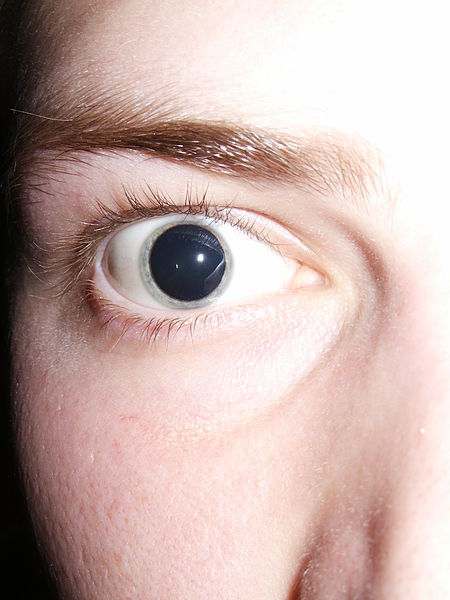
Dilated pupils, via Effect Index
Pupil dilation
A visible enlargement of the pupil diameter (mydriasis) that can range from subtle widening to dramatic saucer-like expansion where the dark pupil dominates the iris. This effect is one of the most recognizable signs of psychedelic and stimulant intoxication and directly contributes to light sensitivity, enhanced color perception, and the characteristic "wide-eyed" appearance.
Description
Pupil dilation, clinically termed mydriasis, is experienced as an expansion of the dark pupil opening that allows significantly more light to enter the eye. The user may first notice the effect by catching their reflection—the pupils appear conspicuously large, with the colored iris reduced to a thin ring around vast dark circles. Functionally, the world appears brighter and more vivid, colors seem more saturated, and light sources take on a more intense, sometimes halo-like quality. In dim environments, the enhanced light sensitivity can feel pleasant and immersive. In bright environments, however, the dilated pupils admit uncomfortably excessive light, producing squinting, eye watering, and photophobia.
The degree of dilation follows a dose-dependent curve. At threshold doses, pupils may be slightly wider than normal—perhaps 5-6mm instead of the typical 3-5mm resting diameter—noticeable only upon close inspection. At moderate doses, dilation to 6-7mm becomes obvious to casual observers, and the person's eyes take on a distinctly alert, wide-open quality. At strong doses, dilation to 7-9mm creates the characteristic "saucer eyes" where the pupil dominates the iris, and the reflex constriction to bright light is noticeably sluggish. At extreme levels, the pupil may be maximally dilated at 8-9mm with virtually no visible iris, and the pupillary light reflex is severely blunted or absent.
Several factors influence the character and duration of mydriasis. Psychedelic mydriasis (LSD, psilocybin, mescaline) tends to be sustained throughout the experience and is bilateral and symmetric. It often co-occurs with enhanced color perception and visual effects. Stimulant mydriasis (amphetamines, cocaine, MDMA) tends to be more variable, fluctuating with sympathetic nervous system arousal. Anticholinergic mydriasis (diphenhydramine, scopolamine, atropine) produces the most extreme and prolonged dilation, sometimes persisting for 24-72 hours, and is accompanied by near-total loss of the pupillary light reflex and paralysis of accommodation (difficulty focusing on near objects).
The pharmacological mechanism involves disruption of the sympathetic-parasympathetic balance governing pupil size. Under normal conditions, the pupillary sphincter (constriction) is controlled by parasympathetic muscarinic innervation, while the pupillary dilator is controlled by sympathetic adrenergic innervation. Substances that increase sympathetic tone (stimulants, via norepinephrine release) activate the dilator muscle. Substances that block parasympathetic activity (anticholinergics) release the sphincter from tonic constriction. Serotonergic psychedelics produce mydriasis through 5-HT2A receptor-mediated inhibition of the Edinger-Westphal nucleus, reducing parasympathetic input to the sphincter.
Mydriasis is most commonly produced by psychedelics (LSD, psilocybin, DMT, mescaline), stimulants (MDMA, amphetamines, cocaine), anticholinergic compounds, and to a lesser degree by cannabis and some dissociatives. It is one of the most universally reliable indicators of psychedelic or stimulant intoxication and is often the first thing noticed by sober observers. Duration varies dramatically: stimulant mydriasis typically resolves within hours, psychedelic mydriasis can persist for 6-12+ hours with LSD, and anticholinergic mydriasis may last days.
While not inherently dangerous, dilated pupils create functional visual impairment in bright environments and significantly increase susceptibility to UV retinal damage. Users should wear UV-protective sunglasses outdoors during mydriasis. Driving is impaired by the altered light response and should be avoided. In social contexts, dilated pupils are a conspicuous marker of intoxication that may draw unwanted attention. If unilateral mydriasis occurs (one pupil dilated, the other normal), this is not typically substance-related and may indicate a neurological emergency requiring immediate medical evaluation.
Intensity Levels
Level 1 — Threshold
20%Subtle widening of pupils to approximately 5-6mm. Only noticeable upon close inspection. Slight enhancement of brightness perception.
Level 2 — Light
40%Clearly dilated pupils at 6-7mm. Observers may comment on the person's 'wide eyes.' Colors appear slightly more vivid. Mild photosensitivity in bright light.
Level 3 — Moderate
60%Prominently dilated pupils at 7-8mm. The dark pupil clearly dominates the iris. Photophobia in bright environments. Sluggish pupillary light reflex.
Level 4 — Strong
80%Very large pupils at 8-9mm with the iris reduced to a thin ring. Significant light sensitivity. Near-absence of light reflex. The characteristic 'saucer-eyed' appearance.
Level 5 — Overwhelming
100%Maximum dilation with virtually no visible iris. Complete loss of pupillary light reflex. Extreme photophobia. Vision may be blurry due to loss of depth of field. Often seen with anticholinergics.